the brilliantly leaping gazelle

Category: My Election Notes 2017

My election notes. E-Day – 16

l

First things first.

What happened in Manchester on Monday night was an outrage. The sudden and violent ending of many lives, with many more wounded, some with life changing injures is something that mere words alone cannot adequately express.

However, this notion – that some tragedy’s are so bewildering enormous in their tragedy that they defy human comprehension – is seemingly beyond most politician’s. Teresa May yesterday could’ve made a speech outside Downing Street briefly expressing her shock and revulsion at the attack and sympathy for those affected, before expounding at length the increased security measures the government was putting in place. But in a telling indictment of the times we now live in, her not doing so, but instead repeatedly expressing sympathy for the victims, revulsion at the perpetrators actions and a determination not to cowed, she would somehow be seen as the embodiment of virtuous human emotion. Does she think that we’ve become so emotionally incapable, so bereft of the ability to articulate how we feel, that we are in some need?

Following the terrorist attack on Westminster Bridge and the Houses of Parliament in March, MP’s were quick to denounce this latest outrage, but were all essentially saying the same thing yet in many different ways. The gist was that the attack was both callous and cowardly, that the people of London stood united and that an attack on Parliament wouldn’t prevent Parliament carrying on as usual. Fine and noble sentiments; if the Speaker of the House had said them to a packed but silent Common’s chamber, and then carried on with the routine business if Parliament. But no. MP after MP made speeches – that to my mind at least – undermined with every word they uttered everything they were saying. For the avoidance of doubt, any terrorist attack, especially one involving the deliberate targeting of children is reprehensible.

Being cynical I have for a long time harboured a suspicion that there is a ready-made emotional response generator that politicians can activate in situations such as these. Rather like this, but reducing heart wrenching suffering into tired cliché. An instant sound bite generator. One that is loaded with stock sincerity and each time it offers up different phrase that can be woven together into a heartfelt statement? I mean, really, who cares what Teresa May, Jeremy Corbyn or Tim Fallon have to say about it? Will they or any other politician offer up anything other than phrases we’ve heard before? Is it that they think that by saying these things they’ll sound like Morgan Freeman, all grim determination and steadfast resoluteness? Will they offer a stunning insight that offers some meaning into the seemingly inexplicable? A pithy but sincere formulation of words that encapsulates a nation’s grief and shock perhaps?

Or will they do what politician’s always do, which is to be seen to be saying the right thing, which – I think –
My election notes. E-Day – 17

It can wait.l

My election notes. E-Day – 18

GR

So Monday brings with it another election treat, in the form of a hasty rethink of Conservative plans to, as the BBC puts it,

 Theresa May has said proposed changes to social care funding in England will now include an “absolute limit” on the money people will have to pay.

The Conservatives ruled out a cap on total costs in last week’s manifesto, instead saying no-one would see their assets fall below £100,000.

The PM defended the “sensible” plan, saying the system risked collapsing.

But she said she wanted to address “shameful” fears that people would be forced to sell their family home.

A rethink that might have been based on the plethora of negative headlines from newspapers that were traditionally Conservative and had an older demographic reading them. It could’ve been that. Or it could have been the fact that whilst house prices have increased since Brexit, as the Guardian reports,

 Asking prices for UK homes hit a new record high over the past month as families in search of bigger properties brushed aside uncertainty caused by Brexit and June’s general election.

Prices sought by sellers rose 1.2% in the four weeks to 13 May, pushing the average asking price to a fresh peak of £317,281, according to the property website Rightmove.

It isn’t a flight of fancy to imagine the European care workers of old people in residential care homes, if they are not guaranteed their right to remain after Brexit, might well return home and therefore increase the cost of residential care home costs by more than any speculative increase in house prices.

Whilst I don’t have a problem with the principle of people making some contribution to their care, I do have a problem with politicians grasping the nettle that is how in a time of austerity we pay for adult social care and then when it gets a bit painful letting go.

Older voters were significantly more likely to vote Leave and now it’s literally payback time.

The law of unintended consequences is wonderful isn’t it!

My election notes. E-Day – 18

EchoChamber

As anyone who’s been following these posts will know, I don’t have an especially good opinion of polls, not just because they were so spectacularly wrong during the last election – although they were – and not just because they manage to base headline grabbing claims out of a statistically irrelevant number of interviewee’s – which I think they do. Nor is it the fact that they dress up all of their guff with sciency sounding assurances that are somehow meant to convince us that their results and actually mean something in the real world.

No what really bothers me about polls is that they’re allowed to be conducted at all. I mean, let them be conducted, fine, let political parties undertake polls to better know which of their policies are playing well to the electorate or not and how they are perceived and the like. But like sex, keep it private.

The problem with polling is, as I mentioned in last Sundays post, the ‘bandwagon effect’, where because people are told something over and over again in the polls, it becomes ultimately self-fulfilling. And as it becomes thus, so the media report on it, rather like an echo chamber. Like an echo chamber the original source is amplified way, way beyond it’s actual significance and as the media report it, it becomes a genuine news story, with no mention in the media of the fact that they’ve helped create the very thing they’re reporting on.

A recent woeful was example set by Donald Trump in his election campaign. It has been variously estimated that he got between $2-5 billion worth of free publicity because of the outrageous comments that he made during the election campaign. Of course, if the media had ignored these, then he would not be president now. But because the news media swiftly reported what he said, and that in turn encouraged other media outlets to do the same, he was able to reach a far greater audience than if his comments had gone ignored or unreported. But the sad fact is that they didn’t. The news needs newness  and and Trump was only too happy to oblige, sometimes even criticizing the very news outlets that were giving him a stick to beat them with.

I’ve long been of the belief that as soon as a general election is called there should be a restriction on the media as to the limits on the reporting of the campaign, not to keep the electorate in the dark, but the opposite. If there was only limited exposure given to only the fact of something happening, rather than endless discussing of what this might mean, bland anodyne reporting instead of increasing biased conjecture wouldn’t that be a good thing? If people weren’t told what others thought but were instead forced to think about what they thought, to examine why they thought what they thought? Why is it that critical reasoning and consequential potentiality have been left to others to frame within their own prism of right and wrong, of what’s good or bad, as if they don’t have their own agenda’s but are merely impartial.

Thankfully we have Chris Morris to illustrate the point.

My election notes. E-Day – 19

H2

Hooray! Let us rejoice! Today is a wonderful day! Henceforth, retailers will no longer be able to sell branded cigarette packets, as a 12-month grace period to allow tobacco firms to phase out old cartons comes to an end. Instead, retailers will only stock plain packets featuring graphic pictures designed to deter smokers. They will also no longer be allowed to stock packets of 10 cigarettes or smaller sizes of rolling tobacco, as part of a package of measures designed to remind us that we are not, as we might foolishly imagine, sentient adults, capable of making rational choices. No we are anything but. And we need to be protected from ourselves.

The problem with this initiative is that it’s indicative of a worrying trend, whereby certain behaviours are deemed to be injurious to health and must be legislated against. But inherent in all this is the fact that received scientific wisdom concerning what is and what isn’t good for us changes. Here’s just a list of some things that were thought bad for us, but are now either not so bad, even good or vice-versa. A comedic example is to be found in Woody Allen’s 1973 film ‘Sleeper’ where Allen plays Miles, the owner of a health food store who is cryogenically frozen in 1973 and defrosted 200 years later in an ineptly led police state. He discovers that foodstuffs considered bad in 1973 are now considered healthy and even cigarettes are seen as healthy

https://www.youtube.com/watch?v=3iG6Hrh4v08

But the here and now, in which we live is fast becoming not so much one where one is able to exercise their own free will, but increasingly obliged to modify one’s bahaviour to appease the will of the state. There are a number of problems with this. Firstly where will it end? A ban on smoking in two places in Bristol was trialled a few years ago, which was after a poll – one of my favourite things – found 61% public support for banning. That poll was of a 1000 people. Hardly justification for banning something that isn’t illegal. Yet. Although Bristol council, emboldened by this ban, is considering issuing contracts for tenants in council houses making it illegal to smoke in them. And not just in Bristol.

And where they have got this idea? Why, in the land of the free, where US public housing agencies have to make all of their properties smoke free by the end of the year. In New York, they’ve already banned it in parks. And might they in turn, get inspired by this guy who this week, according to the Guardian.

Philippines president Rodrigo Duterte has signed an executive order banning smoking in public across the second-most populous country in south-east Asia, creating one of the region’s strictest anti-tobacco laws.

The ban, which carries a maximum penalty of four months in jail and a fine of 5,000 pesos ($100), covers both indoor and outdoor smoking, presidential spokesman Ernesto Abella said on Thursday.

Duterte was himself a heavy smoker but quit when he was diagnosed as suffering from Buerger’s disease, which can cause blockages in the blood vessels.

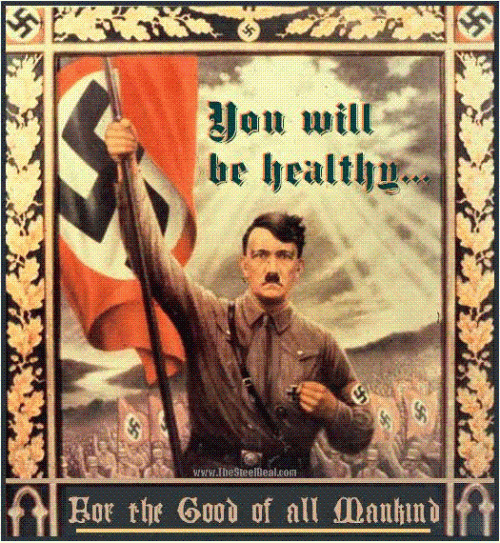
Which of course makes one think of a former smoker, who led his country on zealous anti-smoking initiative, one of many of his health initiatives. A very successful one, apparently. His name was Adolf Hitler, so when people call those who wish to use the law to promote their own health agenda by banning some things and restricting others ‘health Nazi’s’, they aren’t so wide of the mark.

It’s not that I’m pro-smoking but rather that there are other things that pollute our air and causes deaths as smoking, but it isn’t so easy to legislate against.

My election notes. E-Day – 20

oz

At last, a politician with enough common sense to face up to economic reality and face down the ‘grey vote’ and have as a manifesto pledge that the winter fuel allowance will be withdrawn from all but the most needy to help fund adult social care.

Oh I’m sorry. What I meant was someone who wants the electorate, possibly young voters to see Teresa May as acting upon their concerns regarding intergenerational unfairness, whilst actually doing very little.

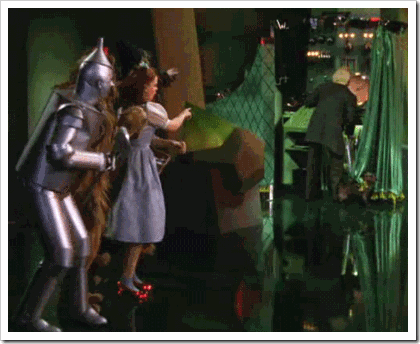
I admit it. I was fooled. I heard the headlines on the radio and thought only good things. Which is, I suppose, the point. Until, like Dorothy in ‘The Wizard of Oz’, the curtain was revealing that there wasn’t a wizard but a small balding man. Only it wasn’t a curtain. It was the combined power of the internet and a few minutes of searching.

Here’s what I found,

 Winter Fuel Payment (WFP) is a tax-free, non-means tested annual payment paid to people aged over the female state pension age. Recipients are not obliged to spend it on fuel. The standard rates are £200 per eligible household where the oldest person is under 80 and £300 for households containing a person aged 80 or over. In 2015–16 it was paid to 12.2 million individuals in over 8.7 million households. It cost DWP £2.1 billion.

And this hidden gem, in the same House of Commons report on intergenerational fairness,

Expenditure on the WFP is falling in real terms as its value is not uprated and the age of eligibility is rising in line with state pension age. In 2016–17 prices the amount spent on WFP has fallen from £2.3 billion in 2011–12 to £2.1 billion in 2016–17 and is forecast to fall further to £1.8 billion by 2020–21. Beyond 2021, the overall number of recipients will rise, as will the proportion of recipients who qualify for the higher rate of payment (for those aged 80 and over). However, as demonstrated by Figure 20, the absence of uprating is likely to prevent total expenditure rising in real terms in the long run.

Or in terms people can understand,

If the WFP were to remain frozen in cash terms in perpetuity, its real-terms value will be eroded by a third over the next 20 years and by a half over the next 35 years.

So just to be clear, the proposed cut is in an expenditure that is falling anyway. So cutting it does away with having to increase it to keep line with rising fuel bills. And because the social care bill will only increase as people live longer, as a gesture it’s that proves that the Conservatives really do put the con in Conservative.

My election notes. E-Day – 21

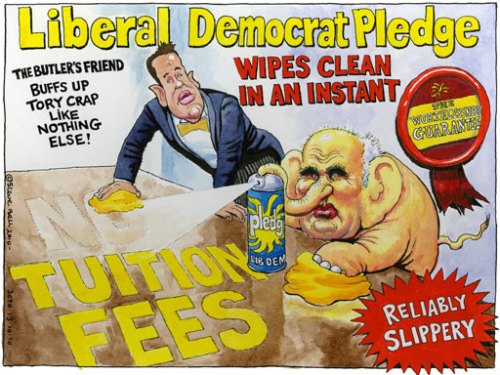
Steve Bell 20.09.2012.

I’ve always been highly suspicious of the Liberal Democrats and it’s a suspicion that they’ve proved to be fully justified. When they knew they had no chance of ever constituting anything approaching an effective political force, they promised all manner of things to woo the electorate. They were like the ‘Goldilocks’ of British politics, inasmuch as they were like the Conservatives but not the Conservatives and they were like Labour but not Labour. They were something different – which was important when your trying to impress your middle-class friends that you too were different – although what exactly that difference was, wasn’t quite clear.

They were partly defined by what they weren’t. They had beliefs, but not what one might call a central unifying one, one that could be summed up in a sentence and was elegantly simple. The Conservatives, for example, are pro-business, pro minimal regulation pro-monarchy, pro-privatisation. Labour are pro-workers rights, pro-trade unions, pro-welfare state, and pro-state intervention for the common good. But the Lib Dems?

But whilst they had successfully managed to inveigle themselves into the electorates collective consciousness as the decent political party, all of that credibility that they’d built up over the years, was exposed expedient posturing in a quite breathtaking act of political opportunism. After the 2010 general election, no one party was able to form a majority government. Some hurried negotiations took place, which saw many Lib Dem manifesto pledges being jettisoned in ‘the national interest’ of having to form a coalition government with the Conservatives.

‘National interest’ was what Nick Clegg claimed he was acting in, but as it turned out, he was acting in political self-interest, and the Conservatives used the Lib Dems craven shamelessness like political Teflon. They weren’t reduced to just a handful of MP’s after the 2015 election, were they? The most embarrassing example – at least the one pledge that they felt compelled to apologise to the electorate for reneging on – was the pledge not to raise tuition fees. Naturally, someone put that apology to music.

So one treats the news that according to the BBC,

 The Liberal Democrats have put a second EU referendum at the heart of their general election manifesto saying it would “give the final say to the British people”.

 The vote on the final Brexit deal would include an option to remain in the EU.

The Lib Dems also say they could generate £1bn from legalising and taxing cannabis.

with the large pinch of salt it deserves. It’s not as if they’ve got a track record that inspires confidence and besides manifesto pledges aren’t even worth the paper they’re written on – as they not legally binding. Unless their manifesto is re-cycled of course. They’d like that. Although not if it was as toilet paper. Thinking of these manifesto pledges – I’ve downloaded their manifesto, so will post about it soon – brings two things to mind.

The first is the old joke. Why did Nick Clegg cross the road? Because he said he wouldn’t!

And the second is from the incomparable genius that is Chris Morris. It’s less than four minutes long so enjoy!

My election notes. E-Day – 23

E2

Last night confirmed something I’ve long suspected about the electorate. Democracy is wasted upon them. They just can’t be bothered to actively take part in the process. Sure, if there’s a televised debate they’ll watch that or they register their feelings on Twatter. Or else they’ll do something, pretty much anything, just as long as it’s passive.

And it was their passivity that struck me forcefully again last night. I’d gone to the Greenwich Theatre to hear Ed Balls give a talk, ostensibly to publicize his new book, but more importantly to reflect upon politics and the state of it now, if it needs improving and how, if it does, that might be effected. That sort of thing. Important things, well to me anyway.

But here’s the thing. The Greenwich Theatre has a capacity of almost 500. It was just under half empty and the vast majority of those who were there over 40, some considerably so. It reminded me of the hustings at the last election in 2015, which I wrote about.

Thursday night was one of the most unedifying experiences I’ve had in a long time. Unedifying because it highlighted the sheer apathy of vast swathes of the electorate. The occasion was a hustings in which all the candidates from my constituency were present and were available to be questioned by members of the public. This was a free to attend meeting, was widely advertised and therefore it was a self-selecting audience – only people who wanted to be there, were there.

 
I went there with a friend who observed that the hall was full and that there were nearly two hundred people in it and that the doors had been closed. A similar amount of people who’d been unable to gain entry to the hall were outside and hadn’t dispersed, so the candidates had an impromptu discussion with them before returning to the main event. This was my friend said a good thing. To me however it was anything but.
 A paltry figure of almost four hundred people attending a public meeting to grill candidates for an election is not a good thing. Not when you consider that population registered to vote in my constituency was 78,605 (in December 2010). Or that the demographic inside the hall was not the same as the demographic outside it.

 Again, it’s a self-selecting audience. It’s one thing people saying that the reason for their lack of engagement in politics is because politics doesn’t mean anything to them, but by the same token it follows that if people are not bothered enough to take an interest in politics, why should politicians be interested in them? As I touched upon in my last blog, it’s a cycle of apathy that politicians publicly decry, but privately delight in.

Is it any wonder then that I commented the previous week that.

 The stark facts are these. At the 2010 election 45.6 million people were registered to vote of whom 29.7 million actually bothered to so. Meaning that 65.1% did and 34.9% didn’t. The Conservatives got 36% of votes cast. So when Brand exhorts non-participation, David, Ed and Nick must be secretly grateful. Because politicians know that the older you are, the more likely to vote you are. Hence their reluctance to cut any benefits to a group likely to kick them in the ballots. Conversely, the younger a voter is the less likely they are to vote, and so cuts to their benefits have little electoral risk.

The older you are not only are you more likely to vote, the less time you’ll have to live with the consequences of that vote; Young people voted overwhelmingly to the stay in the EU, older votes didn’t, and there are more of them. It seems that by not getting what they voted for, they think that participatory democracy isn’t for them

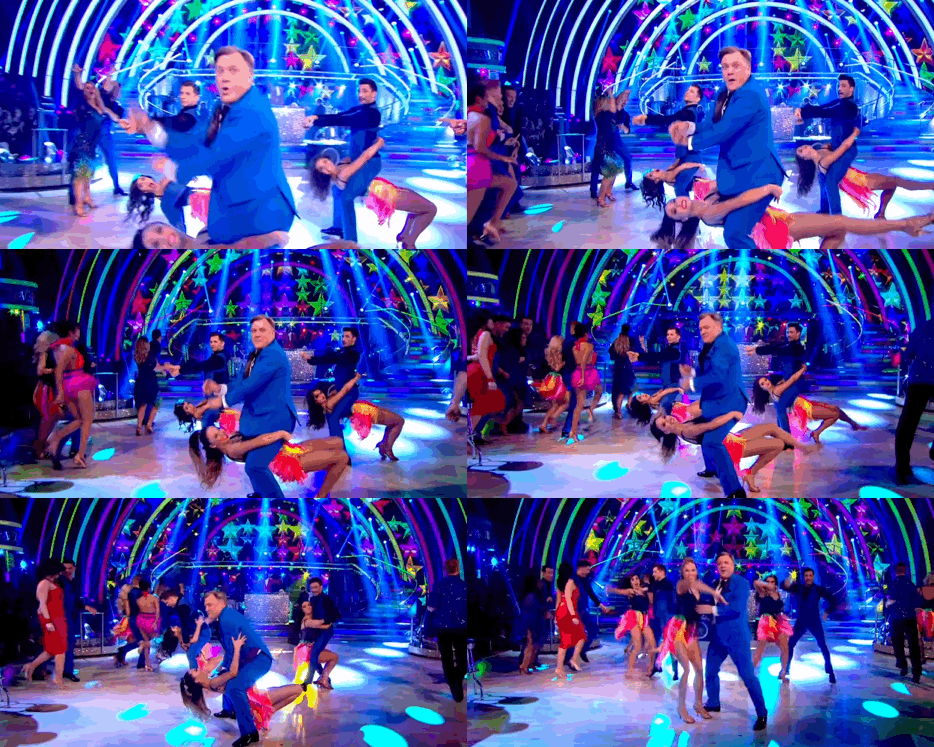
After the talk was over, there was the obligatory book signing by Ed. I was seated quite near him and thus could overhear the conversational exchanges. Worryingly, as soon as most people had finished asking about politics, they all said how much they’d liked him on Strictly Come Dancing.


My election notes. E-Day – 24

**WARNING: THIS POST CONTAINS SPOILERS FOR BOTH ‘LA LA LAND’ AND ‘WITHNAIL & I’.

 AND OH, BY THE WAY IF YOU HAVEN’T SEEN ‘WITHNAIL & I’ BY NOW, YOU’RE A DEMENTED WRONGCOCK**

L2

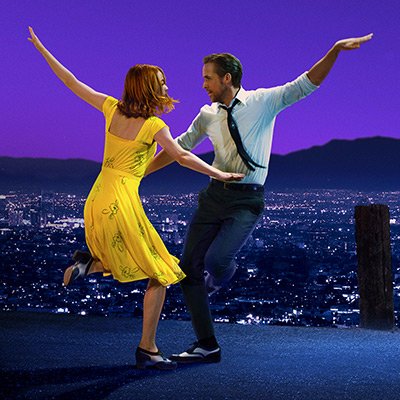
I thought it time to wrestle my thoughts away from the grubby world of things tenuously related to the General Election, and what could be more celebratory, more life affirming, more uplifting and more…well everything than the release today on DVD of ‘La La Land’

From the spectacular opening musical number ‘Another Day Of Sun’   – expertly choreographed on a traffic jam on a Los Angles’ flyover and edited to look as if it was done in one take – it’s as if the film is saying to the audience ‘Sit back, strap on and enjoy the ride, because we’re going to entertain you.’ And unashamedly, it does just that. Rarely does a film deliver on the breathtaking potential that cinema can offer. Rarely does a film not only make you feel better for having seen it, but also have that feeling stay with you for days. The last film I saw that had a similar effect was ‘Strictly Ballroom’ where the audience burst into spontaneous applause at the end. It’s a musical but neither Ryan Gosling or Emma Stone are excellent singers and neither are they excellent dancers. And that’s the point.

Don’t get me wrong, they’re very good but not in a typical musical way. The songs are both witty and poignant. Indeed, the lyrics of ‘Another Day of Sun’ foreshadows the ending. That how often to achieve ones dreams sacrifices have to be made. And the ending is logically consistent with everything that’s happened up until that point. They both get what they’ve always wanted but at the cost of not getting each other. It may not be the typical Hollywood happy ever after ending, but that what makes an otherwise great film, truly excellent.

It’s an ending that – and bear with me here – that reminds me of the ending of ‘Withnail & I’. It is, as I’m sure you’re well aware, one of the funniest films ever made. It’s got great characters – especially the comic and ultimately honourable Uncle Monty – some great one-liners – “We’ve gone on holiday by mistake.” – and some proper swearing. But it’s the ending, with Withnail giving the ‘What piece of work is a man’ speech from Hamlet to a pack of wolves in London Zoo that elevates it from simply being great into truly excellent. In this speech, Withnail reveals his abundant talent, but ironically his alcoholism and drug taking will always prevent him from proving it.

Both films are very different but in their endings they reveal the tragedy of thwarted ambition.


My election notes. E-Day – 25

OS

As anyone who’s been following these posts will know, I’ve returned to the topic of opinion polls more than once, not just because the polls themselves can be manipulated, but more because it only tells one what a statistically insignificant proportion of the population are thinking. There are estimated to be somewhere in the region of 51 million  eligible voters in the UK – whether they’ve bothered to register to vote or not is the subject of another post – and yet typically a survey will ask no more than 4,000 what they think.

And that’s being generous.

So in the Observer today, I was intrigued by a headline on its homepage that announced that;

Nearly 50% are of no religion – but has UK hit ‘peak secular’?

Curiosity piqued, I read on. It stated;

Analysis of data from the annual British Social Attitudes survey and the biennial European Social Survey was carried out by Stephen Bullivant, professor of theology and the sociology of religion at St Mary’s University, Twickenham. “The rise of the non-religious is arguably the story of British religious history over the past half-century or so,” he says in the introduction to his report, The ‘No Religion’ Population of Britain.

It paints a picture of a Britain in which Christianity has seen a dramatic decline – although figures suggest a recent bottoming out in recent years. The avowedly non-religious – sometimes known as “nones” – now make up 48.6% of the British population. Anglicans account for 17.1%, Catholics 8.7%, other Christian denominations 17.2% and non-Christian religions 8.4%.

And for good measure, to make the survey appear to have some methodological integrity so as to reassure us that we could trust what the headlines told us, there was…er nothing.

Nothing at all, no detail as to how many adults were surveyed, how they were surveyed – face to face, telephone or online – or a breakdown of the respondents by geographical region. Annoyed by this, I clicked on the link that the story gave. It took me here. Not helpful.

Most people would have left it there, thought no more about it and enjoyed the good weather we’re having.

But I’m not most people.

I found this on the British Social Attitudes website;

 The British Social Attitudes survey has been carried out annually since 1983 and is our longest running survey. Over 90,000 people have taken part in the study so far.

90,000 people since 1983?

This survey neatly demonstrates how it is possible to extrapolate a meaning from a statistically insignificant amount of people who were asked the same question. In a survey about politics though this matters.

The BBC regularly publishes a poll tracker, which compiles all the data from the major polling organisations and produces a handy graph. Here’s the latest one.

It also adds that;

As everybody knows, the polls got the 2015 general election wrong.

They suggested that the likely outcome was a hung parliament but, as we know, the Conservatives won an overall majority. So is it worth paying attention to them this time?These methodological changes vary from pollster to pollster but there are some general trends.

Several of them now ask the people who take part about their educational background. The aim, as with questions about class, age, gender and region is to get a sample of people who are representative of the population as a whole.

Others have developed more sophisticated ways to estimate how likely it is that somebody who takes part in a poll will actually vote. Just asking people whether they will vote is not a good guide.

Of course, we can’t be sure whether these adjustments will make the polls more accurate. So some people will no doubt decide to ignore them all together.

But there’s still clearly an appetite for them.

No fewer than 30 have been conducted since the Prime Minister made her surprise announcement on 18 April.

That’s more than one a day.

And where does this appetite come from? The very people that commission them and turn them into news!

Inherent in all of this is the danger of the ‘bandwagon effect’,  which Wikipedia describes thusly;

 The bandwagon effect is a phenomenon whereby the rate of uptake of beliefs, ideas, fads and trends increases the more that they have already been adopted by others. In other words, the bandwagon effect is characterized by the probability of individual adoption increasing with respect to the proportion who have already done so. As more people come to believe in something, others also “hop on the bandwagon” regardless of the underlying evidence.

The bandwagon effect occurs in voting: some people vote for those candidates or parties who are likely to succeed (or are proclaimed as such by the media), hoping to be on the “winner’s side” in the end.


That’s the problem with political polls; they help create the very thing they measure.