the brilliantly leaping gazelle

Category: My Election Notes 2017

My election notes. E-Day – 27
six feet while threesome in bed


I’m aware that my last post might have given the impression that my tour of the Houses of Parliament was a total disappointment. Possibly my comparing the tour to a threesome might have helped foster that belief. But just like a threesome – or how I imagine one to be – it was similar to most experiences, inasmuch as the anticipation of it is was far superior than it’s realization.

I mean the tour wasn’t in and of itself bad, although the tour guide imparted a lot of historical guff. Of how someone had done something hundreds of years ago, which had been shocking then, but with the passage of time it has now become a tradition. But there wasn’t anything much about how the procedures and practices of the House had adapted over time, and are engaged in an ongoing process of adaptation to better suit the needs of the people it claims to serve.

I mean, it’s all well and good parliament passing The Equality Act, which imposes legal obligations on employers and organizations not to discriminate, but it also rather handily provides a get out clause for them.

 Duty to make adjustments

(1)

Where this Act imposes a duty to make reasonable adjustments on a person, this section, sections 21 and 22 and the applicable Schedule apply; and for those purposes, a person on whom the duty is imposed is referred to as A.

Because ‘reasonable’ isn’t defined and neither does it stipulate who defines it either. Therein lies the problem. One’s definition of reasonable might well depend on how reasonable the adjustment works for you. In my case, at the Houses of Parliament, on at least two occasions it involved an escorted journey into the bowels of the building, a journey in a lift and then briefly heading outside, before re-entering the building and rejoining the tour.

And even the government is at it. On its gov.uk page it explain ‘reasonable adjustments’ thusly;

Employers must make reasonable adjustments to make sure disabled workers (including contract workers, trainees, apprentices and business partners) aren’t seriously disadvantaged when doing their jobs.

So being  disadvantaged is fine, as long as it isn’t ‘seriously’ Again, there’s no definition.

I know that the building is old and that it wasn’t designed to accommodate people with disabilities. But if Parliament requires society to change, shouldn’t it lead by example. I bet Baroness Tanni Grey-Thompson doesn’t have to deal with this when going about her business as a cross-bench peer? Maybe she does, but if she doesn’t, does that mean that some disabled people are discriminated against more than others?
My election notes. E-Day – 28

six feet while threesome in bed

Yesterday, I went on a tour of the Houses of Parliament. It summed up perfectly what I think is wrong with both the political process and democracy in general. It sounded great in theory but the longer it dragged on, the more increasingly disenchanted with the whole thing I felt, so that by the time it had ended I felt somewhat worse for having participated in it at all.

It’s rather how I imagine I’d feel after a threesome.


My election notes.E-Day -29

survey

There has been lot’s of warnings in the press of the threat posed to the democratic thingy by ‘fake news’. That it might do this or that and how if unchecked, it’s effect could rather be like an angry toddler with only a paint set to play with in a pristine white room.

But this is in part the press deluding itself that ‘fake news’ hasn’t already gained a foothold in all sections of the media. As newsrooms have their budgets cut and with staff under pressure to create copy, this has given rise to ‘churnalism’. It’s basically when a newspaper just copies and paste bits – or all – of s a press release and presents it as a story.

Watch this brief video to see how easy it is.

It’s not the media being exploited so much, as it being a totally inevitable consequence of media economics in the digital age. Why should an editor bankroll a lengthy and costly investigative report that might result in costly legal action, when he has far cheaper alternatives?

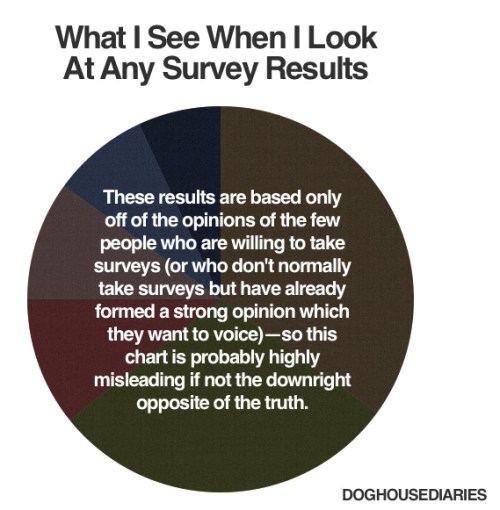
One of my gripes about this election is the media’s reliance on opinion polls. These can hijack the news agenda and in turn influence what policies and proposals are put before the electorate. Why bother announcing something when the chances are how it plays in the polls becomes the story, and not the thing itself. And the thing is no hardly ever looks at polls to see if you’ve either a) provided any details about how many people you interviewed or b) how you interviewed them. This last bit bothers me. A lot.

On Sunday this appeared. This blog followed soon after. So naturally after posting, I signed up with the market research company concerned, Opinium. Only it wasn’t me. Yes they were using my email address, but they were a older semi-skilled white male, educated to  GCSE level, with no particular political affiliations who read a red top. And in the interests of balance they also signed up with YouGov – an online only market research company – only this time as young female of Chinese parentage, with a professional qualification who had strong political opinions.

Anyone can pretend to be anyone online – as dating sites alone prove.

Am I a hypocrite – denouncing that which I decry or am I just proving the very inherent risks in taking online persona’s as anything other than fake? Or if I survey the reader of this blog, might that give me the answer?


My election notes. E-Day – 31

picture 100

The received wisdom, which the results of the local election would seem to confirm, is that the Conservative Party have played a blinder by neutralizing UKIP as a political force so effectively, that they are in danger of becoming a political farce.

In a weird way, I feel sorry for UKIP. Not because their views they espouse are ones I necessarily agree with.  But more that the frustration and cynicism of people with the established political parties that they gave voice to, has in turn been cynically watered down by the Conservative Party.

UKIP forced the issue of a European referendum. Without sustained political pressure from UKIP and media pressure from sections of the most of the press, one wouldn’t have happened. UKIP got 12.6% votes cast in the general election of 2015 remember? To everyone’s surprise, we voted for Brexit. Certainly to Teresa Mays surprise, because she was a Remainer! Therefore it seems plausible, if not certain, that Teresa May might well have been advised to make it seem that she was seeking a strong negotiating position, sending out the right ‘mood music’ and signaling her willingness to walk away from any deal that she though wasn’t in the nation’s best interest. Of course, appealing to those voters that had been lost to UKIP played absolutely no part whatsoever in her decision.

But if it did, was it that much of a shock? Remember the European Elections of 1989? Like it was yesterday I’ll wager. When the Green Party took 14.9% of the vote, causing both the Labour and Conservative parties to confront the truth that the Greens had a message that voters liked? And not just voters, but a significant amount of voters, so significant in fact, that both parties sought to reposition themselves in the minds of the voter as more environmentally aware. So successful were both parties at doing this, that at next European elections in 1994, the Greens only got 3.2% of the vote. Rendering the threat to the political environment nullified and ensuring business as usual.


My election notes. E-Day – 32


Another day, another poll suggesting that something might happen to someone, whereas something else might happen if that someone does something different because some people are feeling something that they could well change their minds about.  Or something.

Yup, there’s another poll in today’s Observer, carried out by Opinium, which states;

The Tories have dropped one point to 46% since last week, while Labour is unchanged on 30%. The Liberal Democrats are up one point on 9% and Ukip is unchanged on 7%.

While Labour has succeeded in clawing back some of the Tory lead, which stood at 19 points two weeks ago, Theresa May’s party would still win a majority of 100.

Oh dear. Someone, somewhere is doing something – but hang on! There’s a caveat here. A small glimmer of hope! The report adds, in something akin to what I imagine would be a schoolboy’s voice when offering a grudgingly mumbled apology, whilst looking downward and kicking his shoes;

if this weekend’s figures are an accurate prediction of what happens on polling day.

What! You mean to say this poll could be wrong? Next thing is you’ll be telling me that they base their findings from a survey of only 20005 people. Oh that’s in the small print is it? Along with the fact that respondents took part online. Well that’s fair enough, I suppose, everything’s done online nowadays. What with it being more modern than a bloke with a clipboard. At least they weren’t paid to take part – oh they were?

But that wasn’t mentioned anywhere in the story. I had to go their website to discover that rather salient fact.

You get cash rewards for each survey that you complete. The average payment is 50p and we pay you when your account reaches twenty five pounds.

Admittedly, one doesn’t get much but that isn’t the point. The point is that not just a only a sad sack like me would think it worth asking to question the survey’s methodology, but also that for a newspaper that frequently takes the moral high ground, isn’t this just a tiny bit something?

My election notes. E-Day – 33

HS

I was watching BBC2’s ‘Newsnight’ yesterday and there’re was a discussion about the local election results, their impact on the parties strategy and the results might be indicative of voting behaviour on June 8th. In the midst of all this they discussed Teresa May; more specifically how she was perceived by voters. One of the panelists, a presenter on a London talk radio station observed that a lot of his callers – regardless of their political affiliation – expressed admiration for Teresa May. Others, he added considered her strong, capable or a combination of all three.

But crucially, when asked to explain why they felt this way, they hadn’t a reason. It was more a feeling, an impression that they got. Another panelist then jumped in. He too had heard the same thing repeatedly on the doorstep. A feeling that she was somehow good without knowing why they thought it.

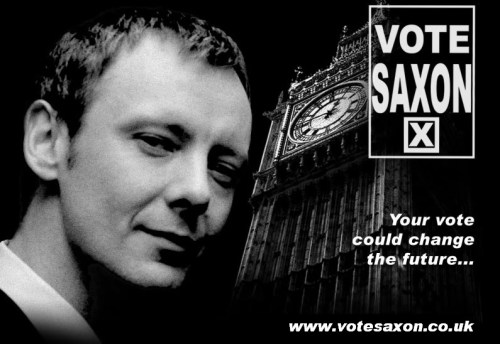
And then it struck me! Teresa May is copying the techniques first perfected by Harold Saxon, Doctor Who’s nemesis ‘The Master’, who finding himself on earth creates an identity for himself as Harold Saxon, an emerging political force. Bear with me. One way he does this is by launching the Archangel network of telecommunication satellites. Only there is embedded in the signal that every user gets is a subliminal message that he is good, he is to be trusted, that he is kind and so on. They don’t know why they think it, they just know he is.

Only he isn’t. And it’s only when it’s too late and becomes Prime Minister that people realise that.

But hey, ‘Doctor Who’ is only voguish science fiction, rooted in far-fetched implausibility populated with robotic villains who screech terrifying stock phrases repeatedly.

Yeah, only make believe.

My election notes. E-Day – 34

wargameThis morning I woke up to the first results from the local elections and they were either very good or very bad, depending on your political allegiance. The Conservatives had their best results in over a decade, the Lib Dems did badly but nowhere near as badly as Labour whilst some in the media have judged UKIP to have been obliterated, having lost all of their seats.
Thinking about UKIP being obliterated,  I thought of last night, specifically me watching ‘The War Game’ again for the first time since I was fifteen. For those of you who don’t know what ‘The War Game ‘is, it was made by the BBC in 1965, and shows the effects on ordinary civilians of a nuclear war. Immediately banned. and never broadcast at the time and only screened over 20 years later, it nonetheless won the Academy Award for best documentary.

One of the pitfalls one exposes oneself when watching something one remembered fondly from ones youth is that it can all too often be a disappointing experience, as one is judging it with a more critical eye. Sometimes things are best enjoyed as memories.

This wasn’t one of those occasions.

Watching it again after so many years,  I was struck by the fact that not only has it stood the test of time remarkably well, but that at fifteen I thought it worth seeing in the first place. I had somehow persuaded my mum to drive quite a way me to a screening of it organised was by C.N.D in a church hall. It was almost like watching ‘A Clockwork Orange’ when it was banned. Both had achieved a near mythical status, but ‘The War Game’s shocking power came from it’s matter of fact approach.

So when Jeremy Corbyn is criticized in the press for saying that if Prime Minister he wouldn’t launch a nuclear weapons is that such a shock. I mean here’s man who when he didn’t have power saying the same thing when he does. I know I’ve got brain damage and everything, but how is that a bad thing? The press would brand him a traitor to his ideals if he suddenly recanted them and use it as evidence of his untrustworthiness. And those politicians who are lauded in the press for being somehow strong for saying they oppose his principled decision, are they not aware that in a nuclear exchange, the effects of the resulting nuclear winter, the radiation sickness affecting billions, the collapse of civil society would not differentiate between who had or hadn’t fired them?

My election notes. E-Day – 35


maxresdefault

As if to neatly underline how much general election coverage has dominated the news agenda these past few days, on the day on which there are local elections and by convention no reporting of political news, there is the shocking news that a 95 year old man will stop doing something.

Never mind that that something often consisted of him making some very ill advised comments, which at the time the press castigated him for.  But now that he’s to stop making them, those very same newspapers can publish them again as a sort of something.

And I don’t mind that. I wouldn’t expect anything else. In the same way I wasn’t surprised by Teresa Mays toadying sycophancy in response to this. The Conservative love the royal family. What I was taken aback by was this:

The Labour leader, Jeremy Corbyn, said: “I would like to pay tribute to Prince Philip following his decision to retire from public service. He has dedicated his life to supporting the Queen and our country with a clear sense of public duty.

“His Duke of Edinburgh’s Award scheme has inspired young people for more than 60 years in over 140 nations. We thank Prince Philip for his service to the country and wish him all the best in his well-earned retirement.”

Because in what way exactly is his retirement well earned? I mean, a teacher earns their retirement. They’ve put the hours in, performed thankless tasks, for poor pay and frequent abuse from politician’s. Same as social workers and countless millions of others who just soldier on from day to day. These are the people for whom whose retirement is well earned. His isn’t.

What hard work has he ever done?  And what is he retiring from? And this public duty that he has such a clear sense of? What in the name of sanity is that? Living off the taxpayer and being a benefit scrounger? If anyone can shed any light whatsoever on anything he’s done that means his retirement is well earned, please leave a comment.

Unless Corbyn meant ‘ I would like to pay tribute to Prince Phillip but sadly I can’t. Whilst he will enjoy a retirement that many can only dream of, the reality is that for some people retirement is a living nightmare.’


My election notes. E-Day – 35


maxresdefault

Today voters go to the polls in the local elections, with councils and some newly created mayoralties – not even sure if that’s a word – up for grabs. But there won’t be a competitive count, where various constituencies race to be the first to call the result. Like it matters.

Anyway, what’s interesting about these local elections, taking place in the midst of a general election campaign, is exactly how much they do and don’t tells us about the electorates voting intention on June 8th. But thankfully, politicians will be on hand  to interpret the same result in different ways.

For example, if the party with previously the highest number of councilors does badly, we might hear something like ‘These results, whilst disappointing in themselves, and lets not pretend that they’re not, are not indicative of voter intention at the general election.’

Whereas if a party, which had previously fared badly does well, we might hear something like this ‘It’s been a wonderful night, not for us, but for the millions of hard-working people who’ve put their trust in us to deliver quality local services.’

And if it’s a party who’ve always struggled in local elections, and have done so again, we might get a variation on this ‘It’s clear that our message, which is proving to be very popular indeed on the doorstep, hasn’t as yet managed to turn itself into votes.’

Or if it’s one of the smaller parties, who have no realistic chance of doing anything but lose the candidates deposit, expect ‘It wasn’t about winning for us, it was about offering the people a real choice, one that is free of tired political dogma and cliché.’

Welcome to the world of elections where no-one ever loses, because if you spin you win!

My election notes. E-Day – 36

The news today that ITV have issued a press release announcing their plans for a televised debate between the party leaders, whilst not addressing contingency plans in the event of multiple no shows to such a debate, is not a huge surprise for a number of reasons.

Firstly, few things happen in any sphere of modern life without a press release or similar to announce it. One gets this a lot in political speeches. Where the text of the speech is given to the press beforehand so it can make the news bulletins and someone can say to camera how someone is expected to say this. And then someone back in the studio can discuss with someone else how something that hasn’t actually happened might affect things.

The benefit in doing this is that if the something is badly received in the media, then it can be claimed to but an exploratory idea or similar and ditched. It’s called doing a ‘reverse ferret’.

Secondly, received political wisdom has it that any meetings with the public are not something that can be carefully controlled by party media managers. Examples of this going wrong and becoming the story are both legion and salutary, as happened today when Tim Notasin was cornered on a walkabout by a pensioner angry at the Lib Dem’s stance on Europe. Although the most shocking example of this was ‘bigotgate’, when the then Prime Minister Gordon Brown was recorded calling someone a ‘bigot’.

Thirdly, this represents a communication echo chamber, made up of the media and the politicians; inasmuch as the media report something and the politicians respond or vice-versa. Crucially, the mainstream media know the rules and will abide by them to ensure continued access.


And whilst I’ve got your undivided attention….

Two more things. It was widely reported today that Teresa May had returned from an audience with the queen to dissolve parliament. Am I alone in thinking that it must’ve been the worst ‘An Audience With….” in ITV’s history? Normally the format of an ‘An Audience With…’ is that of a well loved celebrity who shares anecdotes and generally entertains a celebrity audience. The queen may be many things, but I doubt entertaining is one of them.

And is Teresa May turning in Teresa MayCarthy, seeing dark forces seeking to undermine democracy by exerting undue influence?